

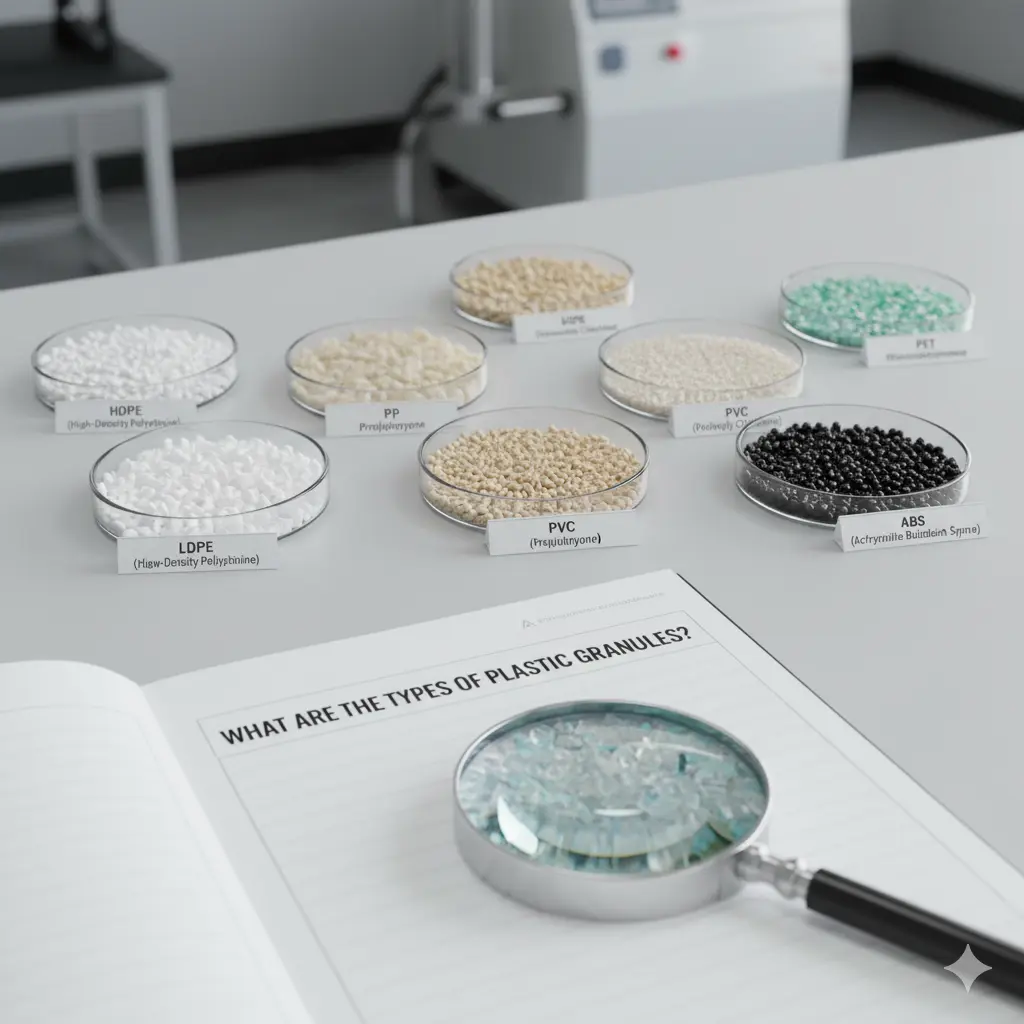
What are the types of granules? Granules are small, solid particles used as raw materials in various manufacturing industries. They are produced in uniform sizes and shapes to ensure consistent processing, storage, and transportation. In the plastics industry, granules are especially important because they serve as the primary form of raw material for processes such as injection molding, blow molding, extrusion, and film production.
Understanding the different types of granules helps manufacturers choose the right material for each application. Granules can be classified based on material type, polymer structure, production method, and end-use application.
Types of granules based on material
Plastic granules
Plastic granules are the most widely used type in manufacturing. They are produced from virgin or recycled polymers and used to make a wide range of plastic products.
Common plastic granules include:
- polypropylene granules
- polyethylene granules
- polystyrene granules
- polyvinyl chloride granules
These granules are used in packaging, automotive parts, construction materials, and household products.
Rubber granules
Rubber granules are made from recycled or virgin rubber materials.
Applications include:
- flooring systems
- sports surfaces
- playgrounds
- shock-absorbing mats
They are valued for flexibility, durability, and impact resistance.
Metal granules
Metal granules are used in specialized industrial applications.
They are commonly used in:
- powder metallurgy
- sintering processes
- welding materials
- abrasive products
Examples include aluminum granules, copper granules, and steel granules.
Types of granules based on polymer category
Polypropylene granules
Polypropylene granules are known for their rigidity, chemical resistance, and lightweight properties.
Applications:
- injection molded household products
- automotive components
- packaging containers
- woven sacks and raffia products
Polyethylene granules
Polyethylene granules are divided into several types.
High-Density Polyethylene granules
Used for:
- rigid containers
- drums and bottles
- crates and bins
Features include high strength and impact resistance.
Low-Density Polyethylene granules
Used for:
- plastic bags
- films
- flexible packaging
They offer softness and flexibility.
Linear Low-Density Polyethylene granules
Used for:
- stretch films
- shrink films
- industrial packaging
They provide excellent tensile strength.
Polystyrene granules
Polystyrene granules are rigid and easy to process.
Applications include:
- disposable products
- food packaging trays
- insulation materials
Types of granules based on production method
Virgin granules
Virgin granules are produced directly from petrochemical processes.
Characteristics:
- high purity
- consistent quality
- predictable performance
They are used in applications requiring strict specifications.
Recycled granules
Recycled granules are produced from processed plastic waste.
Characteristics:
- cost-effective
- environmentally friendly
- suitable for many industrial applications
They support sustainability and circular economy goals.
Types of granules based on processing application
Injection molding granules
These granules are formulated with specific melt flow properties suitable for injection molding.
Used for:
- household items
- automotive parts
- containers and caps
Blow molding granules
Designed for hollow product manufacturing.
Used for:
- bottles
- oil cans
- detergent containers
Extrusion and film granules
Optimized for continuous extrusion processes.
Used for:
- plastic films
- pipes
- profiles
- sheets
Types of granules based on color and additives
Natural granules
Uncolored granules used where appearance is not critical or where color is added later.
Colored granules
Granules pre-colored during production.
Used for:
- consumer products
- automotive parts
- household goods
Additive-modified granules
These granules contain additives such as:
- UV stabilizers
- anti-oxidants
- flame retardants
- fillers
They enhance performance for specific applications.
Why understanding granule types is important
Choosing the correct type of granules helps manufacturers:
- improve product quality
- reduce production defects
- optimize processing efficiency
- control costs
- meet regulatory requirements
Incorrect granule selection can lead to poor product performance or higher manufacturing costs.
How manufacturers choose the right type of granules
Manufacturers consider:
- application requirements
- processing method
- mechanical strength needs
- environmental conditions
- cost targets
- supplier reliability
Technical data sheets and material testing play a key role in decision-making.
Conclusion
Granules come in many different types, each designed to meet specific industrial needs. From plastic granules like polypropylene and polyethylene to rubber and metal granules, understanding the types of granules is essential for efficient and high-quality manufacturing. As industries continue to evolve, the demand for specialized granules tailored to performance, sustainability, and cost efficiency will continue to grow.
FAQs About What are the types of granules?
What is the cost of plastic granules?
The cost of plastic granules varies by polymer type (PP, HDPE, LDPE, PVC, PET), grade (injection, film, blow molding), and whether they are virgin or recycled. Prices typically range from under USD 1 per kg for some recycled grades to over USD 2 per kg for high-quality virgin materials, depending on market conditions and region.
Which countries import plastic granules?
Major importers of plastic granules include China, the United States, Germany, India, Italy, Turkey, and Vietnam. These countries have large plastic manufacturing and packaging industries that rely heavily on imported raw materials.
How to manufacture plastic granules?
Plastic granules are manufactured by collecting raw or recycled plastic, sorting by type, shredding into flakes, washing and drying, melting in an extruder, filtering impurities, and cutting the molten plastic into uniform granules or pellets.
Which plastic granules are best?
There is no single “best” plastic granule. PP is ideal for injection molding, HDPE for strength and chemical resistance, LDPE/LLDPE for flexible films, PVC for pipes and profiles, and PET for bottles and packaging. The best choice depends on the final application.
What are the types of granules?
Plastic granules are classified by polymer type (PP, HDPE, LDPE, PVC, PET, PS, ABS), by source (virgin or recycled), by grade (injection, film, blow molding), and by color (natural, white, black, transparent).
Who buys granulated plastic?
Granulated plastic is purchased by injection molding factories, packaging and film producers, pipe and profile manufacturers, blow molding plants, automotive suppliers, and plastic recycling traders.
What is the price of polyester granules per kg?
Polyester granules usually refer to PET granules. Their price commonly ranges from about USD 0.8 to USD 1.5 per kg, depending on whether the material is virgin or recycled and on regional market conditions.
What does 1 kg of plastic look like?
One kilogram of plastic granules typically fills a medium-sized container or bag, roughly equivalent to a few liters in volume. The exact appearance depends on pellet size, shape, and polymer density.
What are the 7 main types of plastic?
The seven main plastic types are PET (1), HDPE (2), PVC (3), LDPE (4), PP (5), PS (6), and Other plastics such as ABS and polycarbonate (7).
Is there GST on plastic granules?
GST or similar taxes on plastic granules depend on the country. In many regions, plastic granules are subject to standard VAT or GST rates, while some countries offer reduced rates or exemptions for recycled materials.
Who is the biggest importer of plastic?
China is generally considered the world’s largest importer of plastic raw materials, followed by countries such as the United States, Germany, and India, due to their large manufacturing bases.
What is the demand for plastic granules?
Demand for plastic granules is high and continues to grow globally, driven by packaging, construction, automotive, consumer goods, and infrastructure sectors, as well as increasing use of recycled materials.
What is another name for plastic granules?
Plastic granules are also called plastic pellets, polymer pellets, resin pellets, or plastic beads. All terms refer to the same raw material form.
What is the price of plastic granules?
Plastic granule prices vary widely by type and quality. Recycled granules are generally cheaper than virgin ones, and prices fluctuate with oil prices, supply, demand, and regional market conditions.
Where does 90% of the plastic in the ocean come from?
Around 90% of ocean plastic pollution is estimated to come from land-based sources, mainly carried by rivers and poor waste management systems in densely populated regions.
Polypropylene granules in UAE are the perfect choice for industries seeking high-quality, affordable, and sustainable raw materials. With the UAE’s growing position as a global petrochemical hub, investing in polypropylene is a strategic move that ensures competitiveness in international markets.
We invite you to explore Alarkan Plastic’s wide range of high-quality polypropylene and polyethylene granules.
Our innovative and recycled solutions are designed to support your industries with efficiency and competitive pricing.
Contact us today to learn more about our products or request a customized quotation.
We are here to serve your industrial needs.


Join The Discussion